

If your knee hurts every time you climb stairs, walk uphill, or step up onto a box at the gym, the problem often isn’t the knee itself. In my practice, knee pain going up stairs most often comes from the gluteus maximus.
Here’s why that muscle matters so much, what makes it stop working right, and what you can do about it.
Why Your Glutes Cause Knee Pain Going Up Stairs
Your glute max is a powerful muscle that extends your hip, the motion that pushes you up each step. About three-quarters of its fibers also attach into the iliotibial band (IT band), a thick band of connective tissue that runs down the outside of your thigh and attaches near your knee.
Because of that connection, a weak glute max means less stability on the outside of your knee, so the knee caves inward as you climb. That puts more strain on the inside and front of the knee, including the MCL and ACL, and more compression through the outside of the knee.
Low back pain often shows up alongside it. Your glute max helps you hinge at the hips and pick things up off the floor, so when it’s weak, your back takes over.
What Does It Feel Like?
- Pain on the inside, outside, or front of the knee as you step up
- Pain that gets worse with hills, stairs, step-ups, lunges, or squats
- Your knee drifting inward when you climb or squat
- Low back or hip tightness at the same time
What Causes a Weak Glute Max?
Old injuries and compensation. A weak glute max is often the result of an old injury or instability in the hips and pelvis that your body has been compensating for. Balancing and strengthening the pelvic muscles with myofascial therapy helps a lot when this is the cause.
Your hormones and reproductive organs. In Applied Kinesiology, the glute max and many other pelvic muscles are related to the reproductive organs: the prostate, testes, uterus, and ovaries. When there’s stress or dysfunction in those organs, it’s common to see low back pain or knee pain from pelvic instability.
Conditions that may weaken the glutes include, but aren’t limited to:
- Low testosterone
- Low progesterone
- High estrogen
- PCOS
- Prostatitis
- Benign prostatic hyperplasia (enlarged prostate)
- Epididymitis
- Ovarian cysts
- Uterine fibroids
- Cancer (prostate, testicular, ovarian, or uterine)
If your knee pain going up stairs hasn’t gone away with a musculoskeletal approach, it may be time to have your hormones tested. I prefer a salivary test for steroid hormones because it shows how much free hormone you have. Most standard blood tests measure the total, including hormone bound to proteins. Bound hormones aren’t used by the body until it’s in dire need, so knowing your free testosterone, estrogen, and progesterone gives a better picture of what your body is actually using.
For men, I cover the most common causes of low testosterone in Low Testosterone in Your 20s and 30s and how to raise it in How to Naturally Increase Testosterone.
Other Common Causes
Knee pain going up stairs can also come from:
- Patellofemoral pain (runner’s knee), pain around or behind the kneecap
- IT band irritation, often from the same glute weakness
- Arthritis in the knee
- Tight hip flexors or quads from sitting most of the day
Even with these, I often find the glutes are part of the picture.
What You Can Do at Home
- Glute bridges: lie on your back, knees bent, and drive your hips up by squeezing your glutes. 2 to 3 sets of 10 to 15.
- Step-ups: step onto a low step, keeping your knee in line with your toes. Start low and go up as it gets easier.
- Watch your knee: on stairs and in squats, keep your knee tracking over your toes instead of caving in.
- Break up sitting: long stretches of sitting keep your glutes switched off.
If these make your pain worse, stop and get it looked at.
When to See a Doctor
Get checked right away if you have major swelling, your knee locks or gives way, you can’t put weight on it, or the pain started with a fall, twist, or pop.
How I Help
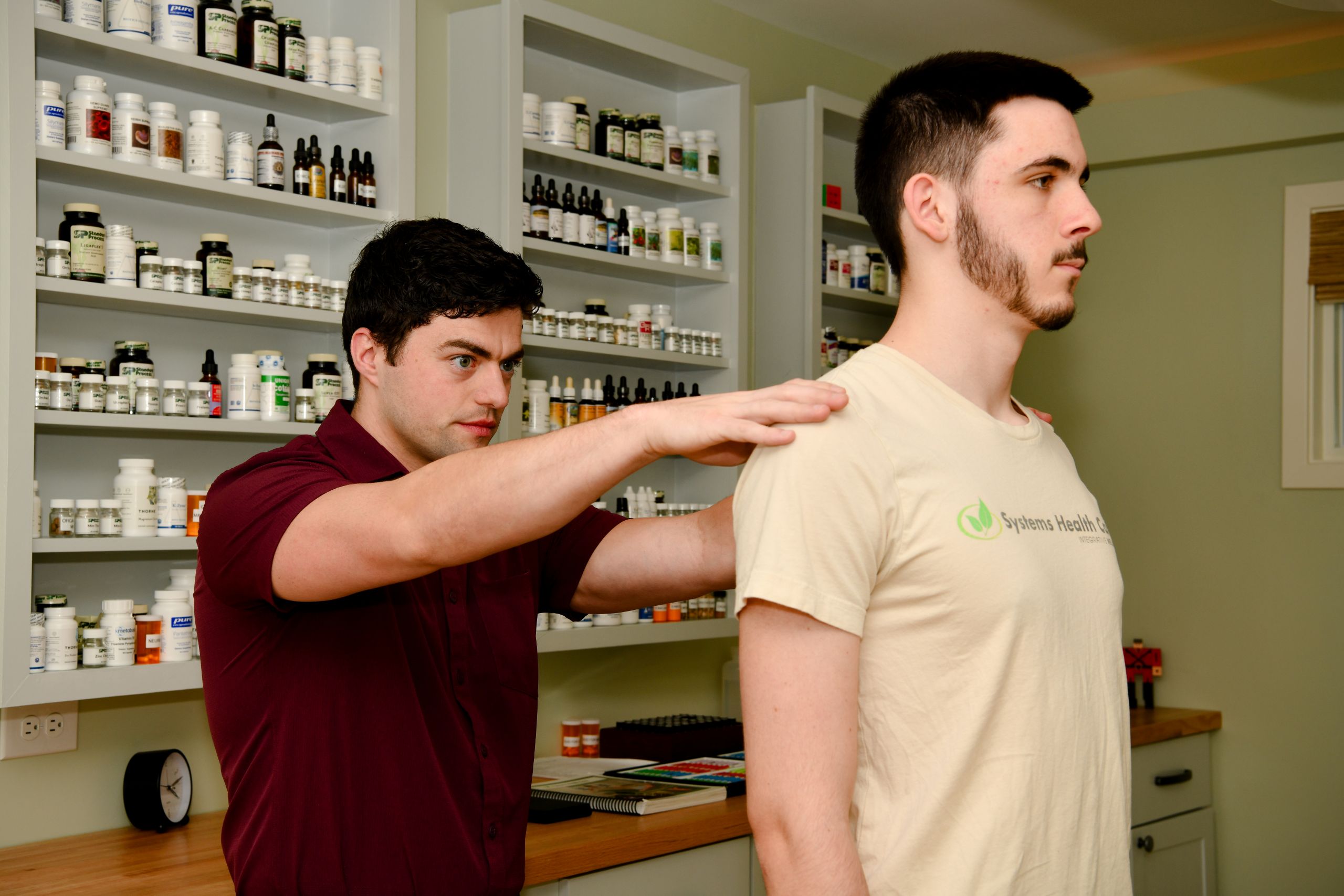
Your first visit is two hours, with a full history, exam, and hands-on treatment the same day. I check the glutes and the rest of the pelvis, hips, and ankles, and use Applied Kinesiology and Systems Health Care to find why the muscle isn’t working, whether that’s an old injury, fascial adhesions, or a hormone issue. Every visit includes hands-on care.
Frequently Asked Questions
Why does my knee only hurt going up stairs?
Climbing relies heavily on your glute max to extend your hip. When it’s weak, your knee loses stability and caves in, which strains the joint.
Can weak glutes cause knee pain?
Yes. Your glute max attaches into the IT band, which supports the outside of your knee. A weak glute often lets the knee collapse inward.
Can hormones cause knee pain?
In my practice, yes. Low testosterone, low progesterone, high estrogen, and other reproductive issues are commonly linked to glute weakness and pelvic instability.
The Bottom Line
Living with chronic knee pain isn’t normal. If your knee hurts going up stairs, look at your glutes, and if strengthening them doesn’t help, look deeper at old injuries and your hormones. A holistic doctor who looks at all of it can help you get back to living pain-free.
Have knee pain going down stairs instead? Read Knee Pain Going Down Stairs.
Not sure what’s behind your knee pain? Book a free 15-minute consult with Dr. Watts.













Leave a Reply
You must be logged in to post a comment.