

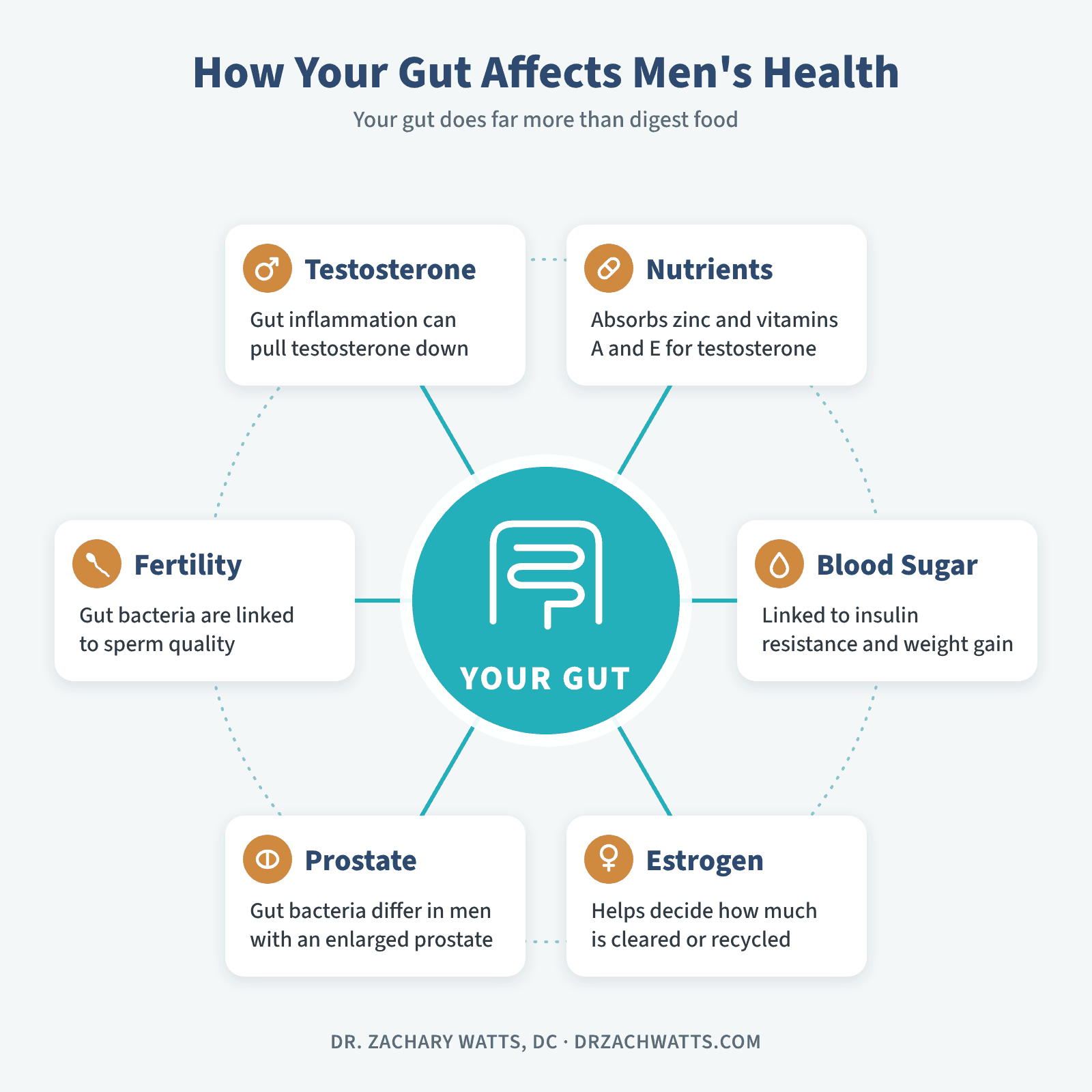
Most guys think of their gut as just digestion. If you’re not bloated or running to the bathroom, it must be fine. But your gut does a lot more than break down food. It controls how well you absorb the nutrients you need to make testosterone, it plays a big role in inflammation, and the bacteria living there even help process your hormones.
That’s why gut health is one of the things I check in men with low testosterone. If you’ve cleaned up your sleep, training, and diet and still aren’t where you want to be, your gut may be the missing piece.
Here’s how your gut affects testosterone, estrogen, your prostate, and fertility, and what you can do about it.
How Your Gut Affects Testosterone
1. Inflammation from a “leaky” gut. Your gut lining is supposed to let nutrients in and keep bacteria and their byproducts out. When that barrier weakens, a bacterial toxin called endotoxin can slip into your bloodstream and drive low-grade inflammation throughout your body. One researcher has proposed this as a reason men with extra body fat so often have low testosterone, a theory he named GELDING (Gut Endotoxin Leading to a Decline IN Gonadal function).
There’s some direct evidence for it, too. In a controlled study, healthy men given bacterial endotoxin had lower testosterone within 6 hours compared with men given a placebo. It’s still a developing theory, but the early evidence points the same direction.
2. Nutrient absorption. You can eat well and still come up short if your gut isn’t absorbing what you eat. The deficiencies I see most often in men with low T are zinc, vitamin A, and vitamin E. Vitamins A and E are fat-soluble, so they depend on healthy fat digestion to get absorbed. Low stomach acid, poor bile flow, or an irritated small intestine can leave you low even when your diet looks good on paper.
3. Gut bacteria help process your hormones. Your body packages hormones like testosterone and DHT so they can be cleared out, and some of them pass through your gut. Gut bacteria can unpack them again. In a 2019 study, gut bacteria turned packaged testosterone and DHT back into their active forms in mice, and young men’s stool had free DHT levels more than 70 times higher than their blood. Researchers are still working out what this means for the testosterone in your blood, but it shows your gut bacteria are part of your hormone system.
4. Blood sugar and body fat. An unhealthy gut is closely tied to insulin resistance and weight gain, and both lower testosterone. Fat tissue also converts testosterone into estrogen, so the problem feeds itself.
Your Gut and Estrogen
Men need some estrogen, but the balance between estrogen and testosterone affects body fat, libido, and mood. Gut bacteria help decide how much estrogen gets cleared out of your body and how much gets recycled back into your bloodstream. Researchers call this group of bacteria the estrobolome. Most of this research has been done in women, but the same process happens in men. I cover the other big drivers of high estrogen in men in How to Naturally Increase Testosterone.
Your Gut and Your Prostate
Research on the gut-prostate connection is newer, but it’s growing fast. A 2026 review of 16 studies found that men with an enlarged prostate (BPH) consistently had different gut bacteria than men without it, along with signs of a weaker gut barrier and more inflammation. The studies were small, and researchers don’t know yet whether gut changes help cause prostate problems or just show up alongside them.
What’s clear is that inflammation and metabolic health affect the prostate, and your gut plays a big role in both. If you have changes in urination, blood in your urine, or pelvic pain, see your medical doctor first to rule out anything serious.
Your Gut and Fertility
In a study published in the journal Gut, researchers transplanted gut bacteria from mice fed a high-fat diet into healthy mice. The healthy mice ended up with lower sperm production and poorer sperm motility. The same team found that men with more of those bacteria had lower sperm motility. It’s early research, but it’s another reason the gut belongs in any plan to improve fertility. More on that in How to Increase Male Fertility.
Signs Your Gut May Be Part of the Problem
- Bloating or gas, especially after meals
- Constipation, loose stools, or switching between the two
- Heartburn or reflux
- Feeling tired or foggy after eating
- Reacting to foods that never used to bother you
- Skin issues like acne or eczema
- Low T symptoms that haven’t improved with better sleep, training, and diet
Some men have no obvious gut symptoms at all, so it’s worth checking even when digestion seems fine.
How to Support Your Gut for Better Testosterone
- Eat real food, including plenty of plants. Get enough animal protein, and add a variety of vegetables, fruits, and other plants to feed your good bacteria.
- Add fermented foods. In a Stanford study, adults who ate more fermented foods like yogurt, kefir, kimchi, and fermented vegetables for 10 weeks had more diverse gut bacteria and lower levels of 19 inflammatory proteins in their blood.
- Cut back on ultra-processed food and alcohol. Both are hard on your gut lining.
- Be careful with NSAIDs and unnecessary antibiotics. Regular use of ibuprofen and similar painkillers can irritate your gut lining, and antibiotics wipe out good bacteria along with the bad. Take antibiotics when you truly need them, and talk with your doctor before changing any medication.
- Manage stress and sleep. Stress changes your gut, and your gut affects how you handle stress. I go deeper in Cortisol and Testosterone.
- Don’t guess with probiotics. Different strains do different things. A random probiotic may do nothing, and some men feel worse on them, especially with an overgrowth like SIBO.
How I Find and Treat Gut Issues
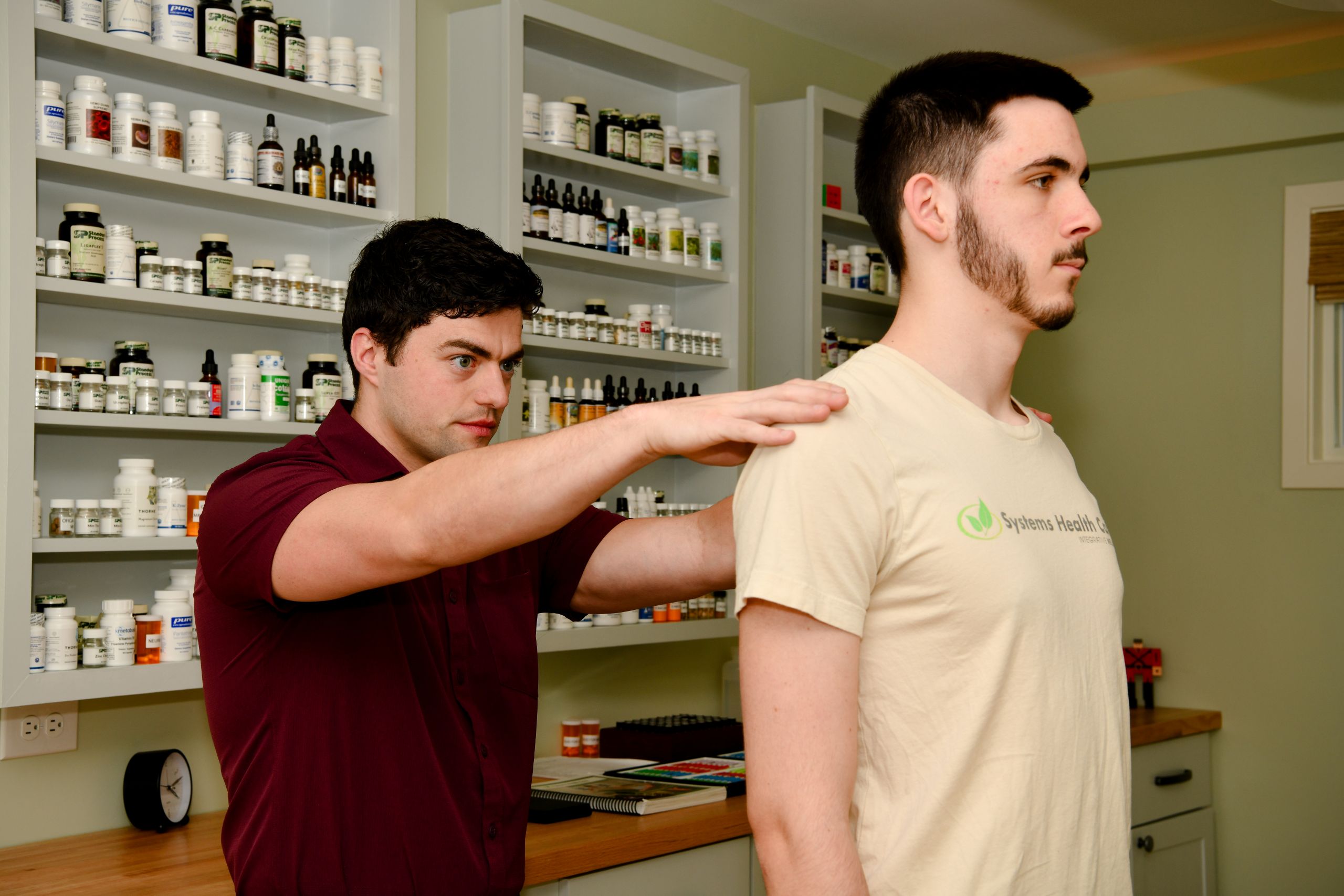
Gut problems don’t always show up on a standard lab test. Your first visit is two hours, which gives me time for a full history and exam. I use Applied Kinesiology to see how your gut, hormones, and the rest of your body are connected, and Systems Health Care to figure out what to treat first. If your gut is the priority, that’s where we start.
When there’s an overgrowth like SIBO or a fungal overgrowth, a few targeted antimicrobial herbs are often needed to rebalance things. Otherwise, the focus is on diet, specific nutrients, and hands-on treatment, which is part of every visit. Most patients leave their first visit with 2 or fewer supplements, and sometimes none.
For more on digestive problems, see IBS: Symptoms and Causes and Natural Remedies for IBS.
Frequently Asked Questions
Can gut problems cause low testosterone?
They can be part of it. Gut problems can drive inflammation, block nutrient absorption, and change how your body processes hormones, all of which can pull testosterone down. They’re rarely the only cause, so I look at the whole picture.
Do probiotics increase testosterone?
Not reliably, as far as we know. One study in mice found a probiotic strain kept testosterone and testicle size up as the mice aged, but good research in men is limited. Fixing what’s wrong with your gut matters more than adding a random probiotic.
Can improving gut health help my prostate?
It may, mainly by lowering inflammation and improving metabolic health, but the research is still early. If you have prostate symptoms, see your medical doctor first to rule out anything serious.
The Bottom Line
Your gut affects how well you absorb the nutrients that make testosterone, how much inflammation your body is dealing with, and how your hormones get processed. If your testosterone is low and the basics haven’t fixed it, your gut is worth a closer look. A quick conversation can help you figure out where to start.
Want the Full Picture?
This is one piece of a bigger approach to testosterone, energy, and performance. See how it all fits together, and what natural options look like before you consider TRT.
Or book a free 15-minute consult with Dr. Watts.











Leave a Reply
You must be logged in to post a comment.