

Knee pain going down stairs or downhill is usually a problem with your quadriceps, the four muscles on the front of your thigh. Your quads control your knee as you lower yourself onto each step, so when they aren’t working right, your knee takes the hit.
Here’s what usually causes it, including a few causes most people would never think of, and what to do about it.
Why Your Quads Cause Knee Pain Going Down Stairs
Going down stairs is a slow, controlled bend of the knee. Your quads lengthen under load to brake each step. All four quad muscles pull on your kneecap at slightly different angles, so they need to work together. When one is weaker than the others, the kneecap doesn’t track smoothly, and the extra wear and tear leads to pain.
What Does It Feel Like?
- Pain around or under the kneecap when you step down
- Pain going downhill, lowering into a squat, or sitting down in a chair
- Pain after sitting for a long time
- Grinding or clicking under the kneecap
What Causes Weak Quads?
Most often, the weakness comes from:
- An old injury or fascial adhesions
- Pelvic, hip, or ankle instability
- A reaction to a medication or supplement
- IBS, SIBO, or SIFO
Old Injuries and Fascial Adhesions
Scar tissue, trigger points, or fascial adhesions in one of the quads, or a muscle near the knee, can throw off the balance between the four muscles. This is usually best addressed with hands-on treatment to the area, ideally by someone who can feel exactly where the tissue is tight.
Pelvic, Hip, or Ankle Instability
The pelvis, hips, and ankles have a huge effect on your knees. It’s well known across many professions that knee pain often comes from the joint above or below the knee. Each of these joints could be an article of its own, so it’s important to have someone take the time to check each one for instability.
Supplement or Medication Reactions
In Applied Kinesiology, the quads are related to the small intestine. They tend to weaken when a supplement or medication is irritating the small intestine. If your knee pain started after a new supplement or medication, consider pausing the supplement to see if the pain improves. Always talk with your prescribing doctor about possible side effects before changing a medication.
IBS, SIBO, or SIFO
Because the quads are related to the small intestine, a bacterial overgrowth (SIBO) or fungal overgrowth (SIFO) can keep them from working properly. A few different antimicrobial herbs are often needed to balance the gut flora. Learn more in Irritable Bowel Syndrome (IBS): Symptoms and Causes and Natural Remedies for IBS.
Other Common Causes
Knee pain going down stairs can also come from:
- Patellofemoral pain (runner’s knee)
- Patellar tendinopathy (jumper’s knee), pain just below the kneecap
- Arthritis in the knee
- A meniscus problem, especially with locking or catching
Even with these, the quads are usually part of the picture.
What You Can Do at Home
- Slow step-downs: stand on a low step and slowly lower one heel to the floor, keeping your knee over your toes. Start small and go slow.
- Wall sits: hold a partial squat against a wall for 20 to 45 seconds, pain-free.
- Box squats: squat to a box or chair. Avoid using momentum to stand up. 2 to 3 sets of 10 to 12.
- Take stairs one at a time for now, leading with the good leg going down.
- Notice patterns: if pain started with a new supplement, medication, or gut symptoms, write it down.
If these make your pain worse, stop and get it looked at.
When to See a Doctor
Get checked right away if you have major swelling, your knee locks or gives way, you can’t put weight on it, or the pain started with a fall, twist, or pop.
How I Help
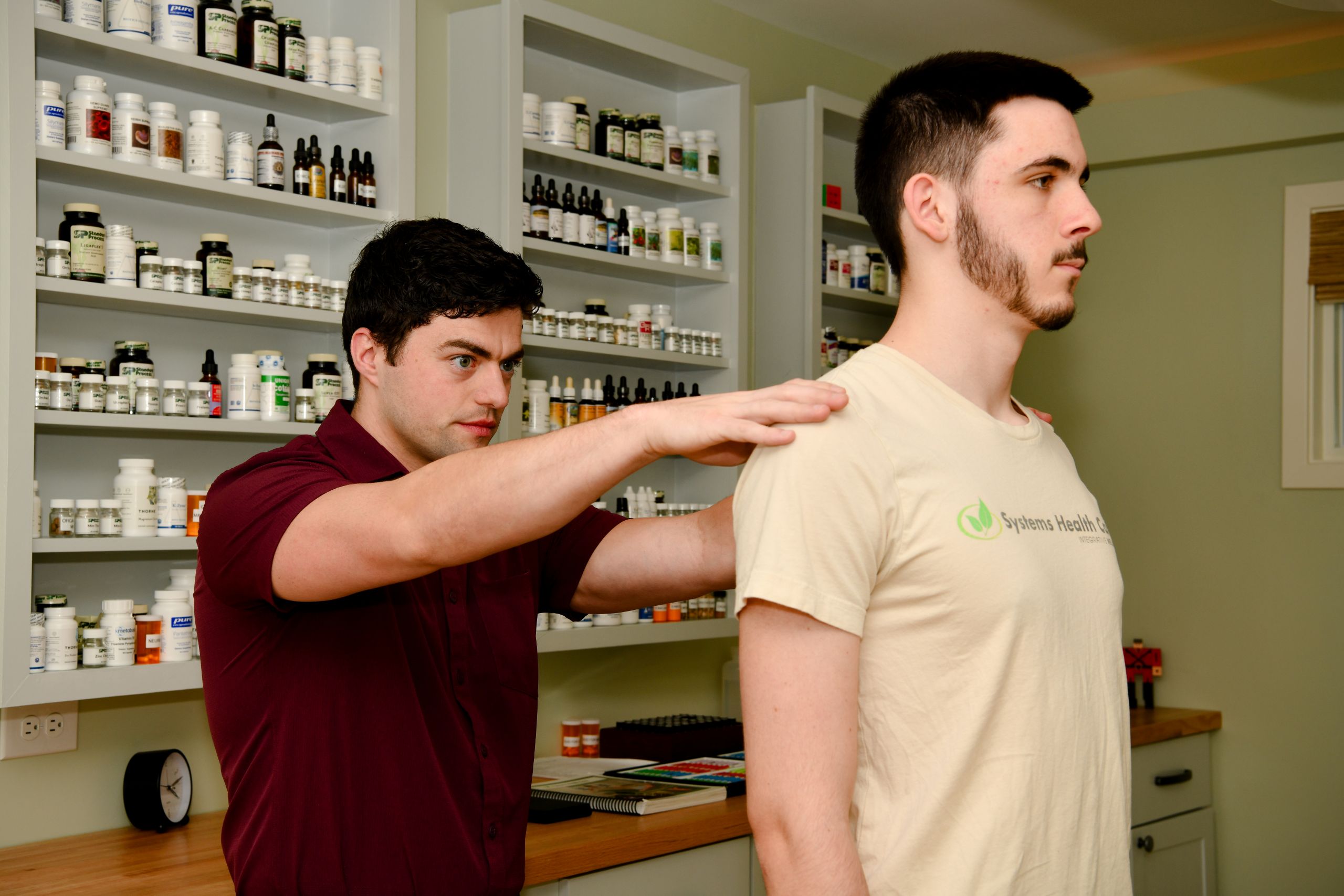
Knee pain can be more complex than it seems. Your first visit is two hours, with a full history, exam, and hands-on treatment the same day. I check all four quads, the pelvis, hips, and ankles, and use Applied Kinesiology and Systems Health Care to find the cause, whether it’s an old injury, a joint above or below the knee, or something in your gut. Every visit includes hands-on care.
Frequently Asked Questions
Why does my knee hurt going down stairs but not up?
Going down relies on your quads to brake each step. Going up relies more on your glutes. Pain only going down usually points to the quads.
Can gut problems cause knee pain?
In my practice, yes. In Applied Kinesiology, the quads are related to the small intestine, and issues like SIBO, SIFO, or irritation from a supplement or medication often show up as quad weakness and knee pain.
Is knee pain going down stairs a sign of arthritis?
It can be, but often it’s a muscle imbalance around the knee. A thorough exam can tell the difference.
The Bottom Line
Don’t put up with knee pain longer than you need to. Pain going down stairs usually starts with the quads, and the reason they’re weak can be an old injury, a joint above or below the knee, or even your gut. Find the cause and fix it.
Have knee pain going up stairs instead? Read Knee Pain Going Up Stairs.
Not sure what’s behind your knee pain? Book a free 15-minute consult with Dr. Watts.













Leave a Reply
You must be logged in to post a comment.